
Integration guide
Koven batteries, read directly
SavvyVan3 talks to Koven batteries over wireless and reads them directly - state of charge, current, voltage and history, straight from the battery’s own management system. No shunt to buy, and nothing extra to wire.
At a glance
- Connects
- Directly over wireless - no shunt needed
- Shows
- State of charge, volts, amps, watts and history
- In the list as
- Begins DP04S, not the brand name
- Needs
- A SavvyVan3 panel on the latest software
- Also feeds
- Water heater control
Before you start
Make sure your panel is on the latest software. Battery support improves with almost every release, and a panel a few versions behind may not recognise your battery. Update instructions are in the SavvyVan3 user guide.
A van uses one source of battery data - a SavvyShunt, or a battery that reports itself, never both. With a Koven battery you do not need a shunt, and fitting one anyway gives you two versions of the truth.
Pairing it
- On the panel, open Installer Settings and go to the device pairing screen - the one with Scan on the right-hand side.
- Tap Scan and give it a few seconds to look around.
- Tap the + beside
DP04S. That is your Koven battery. - Wait for the symbol to turn blue. That is the panel telling you it is connected.
- Tap the home button. Your battery is now on the main screen, showing live data.
What you get
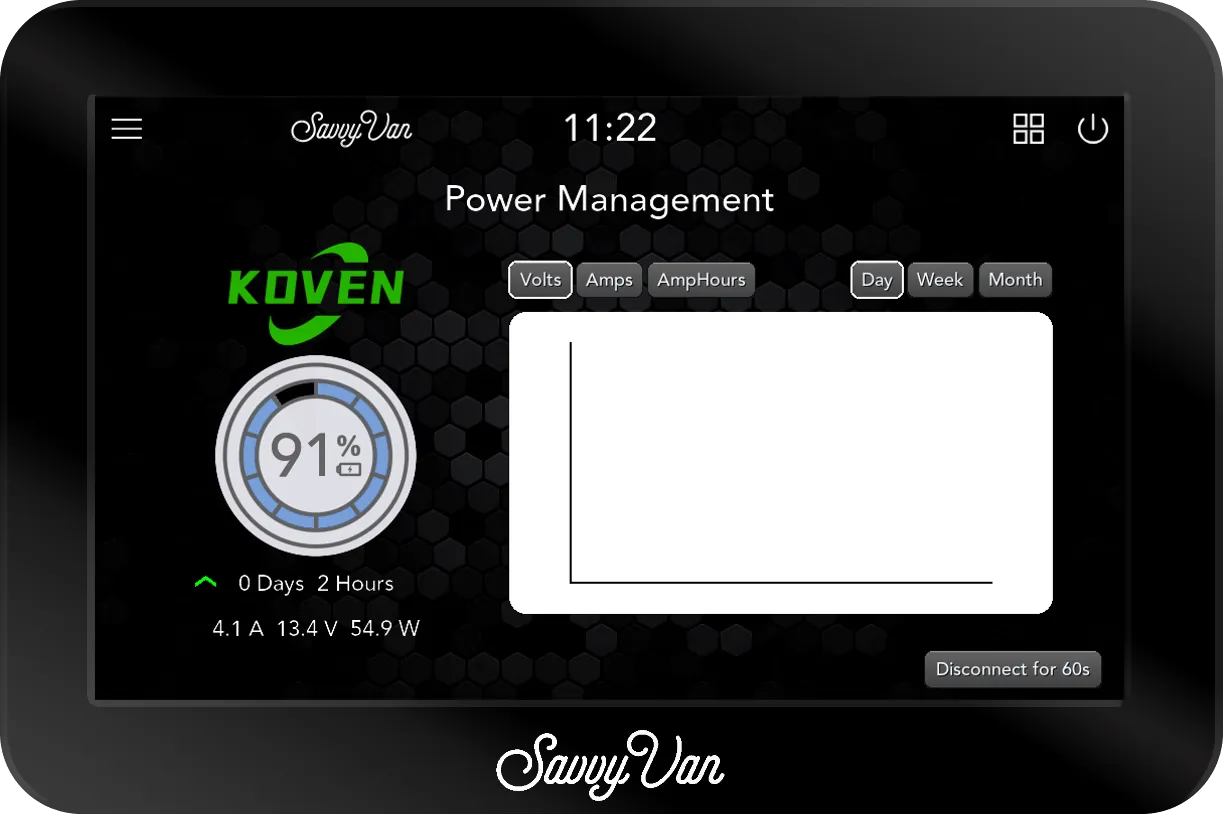
State of charge comes from the battery’s own management system, so it is a figure the battery is certain of rather than one inferred from voltage. Along with it you get live current in and out, voltage, watts, and the history behind them.
That data feeds the rest of the panel too: water heater control can use spare charge rather than leaving it in the battery.
Looking at the cells
Because the panel is talking to the battery’s management system rather than measuring from outside, it can also show you what is going on inside the pack. Under Battery Settings you get the number of cells, the average cell voltage, every individual cell voltage, the gap between the highest and lowest, whether the balancer is working and how hard, and the pack’s temperature sensors.
Most of the time you will never look at it. The one time it matters - a cell drifting away from the others, which is how a lithium pack usually starts to fail - you can see it on the van’s own screen, without a laptop and somebody else’s app.
If it does not appear
- Check the software version first. It is the most common cause by a mile.
- Look for
DP04S, not Koven. Easily the commonest reason someone thinks their battery has not appeared. - Close anything else that talks to the battery, including a phone app. A battery holds one connection at a time.
- Get closer. Pair from inside the van, near the battery, rather than from the other side of a metal wall.
Still nothing? Tell us what you are seeing - including the name the battery shows up as, if it shows up at all. That one detail usually settles it.
Questions people ask
- There is no Koven in the list, only DP04S. Is that right?
- Yes - that is your battery. Koven packs advertise themselves by their management system rather than by the brand on the case, so DP04S is what you are looking for.
- Do I still need a SavvyShunt?
- No. A Koven battery reports its own state of charge, so the shunt would be measuring something the battery already knows. A van uses one source of battery data - either a shunt or a direct battery connection, never both.
- Does it work with more than one battery?
- The panel reads one battery source. If you have several batteries wired as a bank, connect to the one reporting for the bank.