
Installation guide
Fitting the Ultra Low Current Driver
The ULCD opens a 12V gas solenoid with a burst of full power, then drops to 0.09A to hold it there. That is the difference between a solenoid you can leave open all evening and one that quietly flattens your battery.
At a glance
- Drives
- 12V solenoids - gas isolation, typically
- Holding current
- 0.09A
- Supply
- 12V DC only, switched and fused
- Polarity
- Sensitive - reversing it can damage the solenoid or the driver
- Mounting
- Dry and protected. No water, no humidity
- Fuse
- 2A in-line, close to the supply
Wiring it in
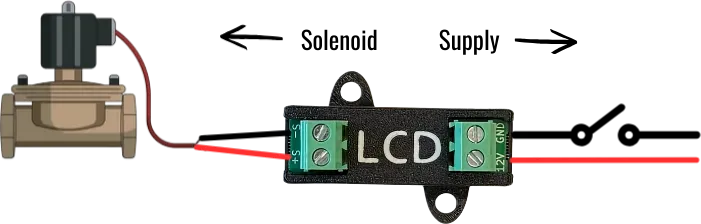
- Solenoid to S− and S+. Get the polarity right - reversing it may damage the solenoid or the driver.
- Supply to 12V and GND. Use a switched and fused 12V feed. We recommend a 2A in-line fuse close to the supply.
- Double-check everything before you reconnect power.
Where to mount it
- Dry and protected. No water, no high humidity. This is not a wheel-arch part.
- Firmly secured, so it cannot move or rattle about.
- With some air around it, so heat is not trapped against it.
- Reachable. It is a serviceable part, so mount it where it can be reached, disconnected and removed without dismantling fixed furniture or bonded panels.
Safety
This is 12V vehicle electrics, so the short list matters more than the long one.
- 12V DC only. Never connect it to another voltage, and never to AC.
- Low-current solenoid loads only. Going over its rating risks overheating or permanent damage.
- Polarity sensitive, on both sides.
- Disconnect the 12V supply before making or changing any connection.
- Fuse it. An appropriate in-line fuse close to the power source protects against a short.
- Do not modify it. Unauthorised changes can make it unsafe as well as broken.
- Have it fitted by a suitably qualified person. If 12V DC wiring is not your territory, there is no shame in asking one, and it is cheaper than the alternative.
Questions people ask
- Do I need one if I have SavvyTanks V3?
- No. SavvyTanks V3 has the same driver built in, so a separate ULCD is only for systems without it.
- Does it pair with the panel?
- No - it is a standalone piece of electronics rather than a wireless add-on. It does its job whether or not a panel is watching.